Forex trading for beginners starts with one currency pair, a demo account and a written risk limit
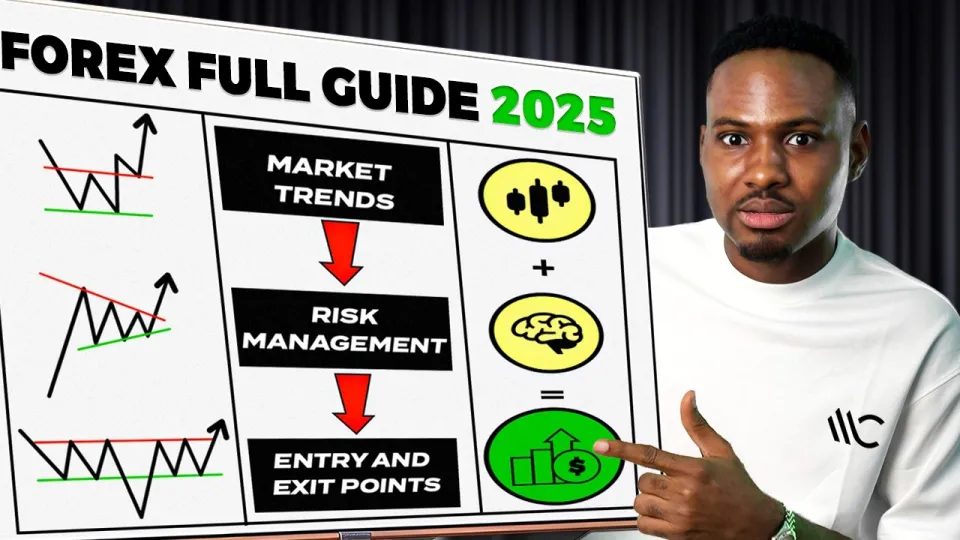
Video: How To Start Forex Trading For Beginners’ 2025 (Full Course)
Want articles like this for your own video to promote it on YouTube and Google? Order them through the Telegram bot @sat_sit_bot. The bot writes and publishes the articles itself (with your YouTube video embedded) on popular topical websites (no ads). Your first 50 articles are free.
· based on the channel Jeffrey Benson Forex
Key takeaways
- Forex is the exchange of one currency for another; retail traders speculate on price changes of pairs such as EUR/USD through a broker.
- The market runs 24 hours a day, five days a week, split into four sessions: Sydney, Tokyo, London and New York.
- A beginner needs a broker account, a platform such as MT5, a demo account and a trading journal before risking real money.
- Risk per trade should stay at 1–2% of the account; this single rule decides whether a beginner survives the first year.
- Jeffrey Benson Forex structures its beginner course around market basics, tools, strategy foundations, a first trade and common mistakes.
Forex trading for beginners is the process of learning how currency pairs move, opening a broker account, practising on a demo platform and risking only a small, pre-defined share of the account on each trade. The fastest route is to study the market structure first, then place dozens of demo trades with a written plan before funding a live account. A structured starting point is the beginner course offered through the Fire Pips FX plans page, which walks through the same sequence: basics, tools, strategy, first trade and risk control.
What forex trading actually is and who moves the prices
Forex is the market where one currency is exchanged for another, and retail traders profit from changes in the exchange rate of a pair rather than from owning the currency itself. Every quote has two sides: the base currency on the left and the quote currency on the right. In EUR/USD at 1.0850, one euro costs 1.0850 US dollars, and a move to 1.0900 means the euro strengthened against the dollar.
The participants behind those moves are not only speculators. Central banks set interest rates, commercial banks make the largest volume of transactions, importers and exporters hedge real business flows, and funds trade on macro views. Retail traders sit at the smallest end of that chain, which is why the beginner's edge never comes from size but from selectivity and risk control.
Three practical consequences follow from this structure:
- Currency prices react mainly to interest rate expectations, inflation data and employment reports, so a beginner should know the release calendar before opening a position.
- Spreads and commissions are a real cost; a strategy that needs 50 trades a week to work is usually a strategy that pays the broker, not the trader.
- Leverage is borrowed exposure, not extra capital. At 1:100, a 1% move against a position wipes out the entire margin behind it.
How the forex market works across four sessions
The forex market is open 24 hours a day from Sunday evening to Friday evening, and its behaviour changes with the session that is active. Sydney opens the week, Tokyo follows, then London, then New York, with overlaps where volume and volatility peak.
The London–New York overlap is the busiest window of the day and produces the cleanest intraday moves on majors such as EUR/USD and GBP/USD. The Tokyo session is quieter and often ranges, which suits different tactics than the London open. Beginners who cannot watch charts all day usually pick one session, one pair and one setup, and ignore everything else.
Tools a beginner needs before the first trade
A working forex setup is small: a regulated broker, a trading platform, a chart with two or three indicators at most, an economic calendar and a journal. Anything beyond that is optional until the basics are consistent.
- Broker account. Regulation, spreads, execution quality and withdrawal terms matter more than bonuses. The course author points beginners to Assex Markets registration at https://my.assexmarkets.com/auth/register?partner_code=1699134, and any broker choice should still be checked against your local rules.
- Platform. MetaTrader 5 (MT5) is the standard: charts, order types, pending orders and a strategy tester. Linking the broker account to MT5 takes minutes and should be done on demo first.
- Demo account. A demo account is not a game; it is where a beginner proves the plan works over at least 50–100 trades before real money is involved.
- Economic calendar. Rate decisions from the Federal Reserve, the ECB and the Bank of England, plus CPI and non-farm payrolls, explain most of the sudden spikes that stop out beginners.
- Trading journal. Screenshot every entry and exit, note the reason, the result in pips and in percent of the account, and review weekly. Without a journal there is no way to tell skill from luck.
The strategy foundation that keeps beginners in the game
A beginner strategy needs only three decisions: where to enter, where the idea is wrong, and how much is at risk. Everything else is refinement.
Start with market structure. On a higher timeframe such as the 4-hour or daily chart, mark the recent swing highs and lows. An uptrend prints higher highs and higher lows; a downtrend does the opposite. Trade in the direction of that structure rather than against it, and use a lower timeframe only to time the entry.
Then define risk before reward. If a stop loss sits 30 pips away and the target is 60 pips away, the trade offers a 1:2 reward-to-risk ratio and needs to win only about 34% of the time to break even before costs. Risk per trade should stay at 1–2% of the account, which means a $1,000 account risks $10–$20 per position. Position size follows from that number and the stop distance, not from how confident the trader feels.
Finally, write the rules down. A one-page plan covering the pair, the session, the setup, the maximum number of trades per day and the daily loss limit turns trading from impulse into process.
Placing a first trade step by step
A first trade is a mechanical sequence, and following it in order removes most beginner errors. Open the chart of one major pair, confirm the direction on the higher timeframe, then move down to time the entry.
- Check the economic calendar for high-impact releases in the next few hours and avoid opening minutes before them.
- Mark the nearest support and resistance on the 4-hour chart and decide whether price is trending or ranging.
- Set the entry, the stop loss beyond the structure that would invalidate the idea, and a take-profit at least twice the stop distance away.
- Calculate lot size so that the stop loss equals 1–2% of the account.
- Place the order, then leave it alone; moving a stop loss wider is the most expensive habit in retail forex.
- Log the trade in the journal with a screenshot and a one-line reason.
Common mistakes that cost beginners their accounts
Most beginner losses come from a short list of repeated errors rather than from bad analysis. Overtrading is the first: boredom produces trades with no setup, and each one pays spread. Overleveraging is the second: a position that feels small at 1:500 leverage can erase months of progress in one candle.
Revenge trading after a loss is the third, and it usually breaks the daily loss limit that would have protected the account. Ignoring news is the fourth, because a rate decision can jump 80 pips in seconds and skip the stop. Finally, switching strategies every week guarantees that no method ever gets a fair sample of trades.
Questions beginners ask most often
Many viewers of beginner courses want to know how long it takes before trading becomes profitable. The honest answer is months, not days: plan on several hundred demo trades and at least one full quarter of small live positions before judging results. Others ask whether a large account is required. It is not — a small account with 1% risk teaches the same lessons, and it costs far less to learn them.
A frequent doubt is whether signals can replace learning. Copying trades can show what a valid setup looks like, but without understanding the stop and the risk, a copied trade becomes an unmanaged position the moment the provider is offline. Another common question is which pair to start with: EUR/USD is the usual choice because of tight spreads and deep liquidity, and one pair is enough for the first year.
Useful links from the course
- Student plans and the full beginner course: https://firepipsfx.com/plans
- Free daily signal channel: https://t.me/firepipsignals
- Broker registration used in the course: https://my.assexmarkets.com/auth/register?partner_code=1699134
- Premium signal group access: https://t.me/jeffreybenzhelpbot
Final takeaway
Forex trading rewards process over prediction, and the beginners who last are the ones who treat risk per trade as non-negotiable, practise on demo until the plan is boring, and journal every decision. The Jeffrey Benson Forex full course follows exactly that order — market basics, tools, strategy foundation, a first trade and the mistakes to avoid — and it is a practical map for the first year. Start with the free material, then commit to a written plan before funding anything. If you want the structured route, begin at the Fire Pips FX plans page and work through the course in sequence.
Source: How To Start Forex Trading For Beginners’ 2025 (Full Course) · Markdown version
Questions & answers
How much money do I need to start forex trading?
You can open a live account with a few hundred dollars, but the amount matters less than the risk rule. With 1–2% risk per trade, a $500 account risks $5–$10 per position, which is enough to learn execution and psychology without damaging losses. Many beginners stay on demo until they have 50–100 logged trades.
Can I learn forex trading for free?
Yes. Broker demo accounts, MT5, economic calendars and free video courses cover the basics at no cost. Paid material usually buys structure and feedback rather than secret information, so finish the free foundation first and only pay for education you can verify.
How long does it take to become consistently profitable?
Realistically six to twelve months of deliberate practice, including a demo phase and a small live phase. Progress depends on journaling and reviewing trades, not on screen time alone; traders who change strategy every week rarely reach consistency at all.
Is copying signals a good way to start?
Signals can be useful for seeing valid setups and learning how stops are placed, but they do not teach risk sizing or trade management. If you copy trades, keep the risk small and study the reasoning behind each entry rather than treating the signal as a shortcut.